
BREAKING: New Study Reveals WHY Regulators Missed the DNA Contamination in mRNA Vaccines
The answer was hiding in plain sight—and it explains everything.

Nearly three years ago, genomics scientist Kevin McKernan made an accidental discovery that would shake the foundations of mRNA vaccine safety claims. While running experiments at his Boston lab, he used Pfizer and Moderna vaccine vials as controls—and was shocked to find them contaminated with plasmid DNA fragments at levels he estimated were 18-70 times higher than regulatory limits.
The establishment response was predictable: McKernan was dismissed, his work was “fact-checked,” and regulators assured us everything was fine. The vaccines were safe. The DNA was negligible. Move along.
But McKernan didn’t move along. And now, a newly published study in the Journal of Independent Medicine finally explains why the regulators missed it—and why their testing methods were fundamentally flawed from the start.
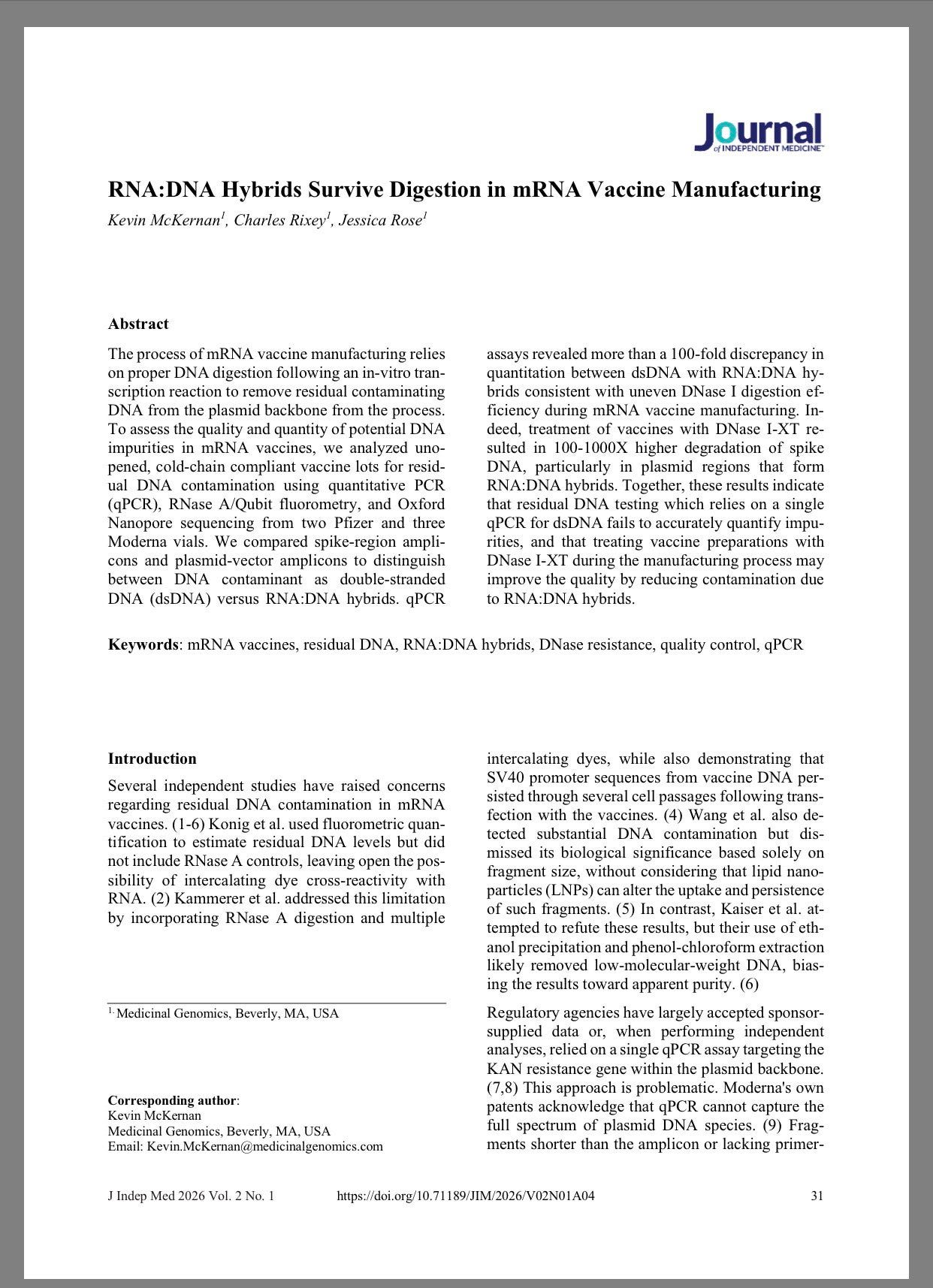
The Study: “RNA:DNA Hybrids Survive Digestion in mRNA Vaccine Manufacturing”
On January 13, 2026, McKernan and co-authors Charles Rixey and Jessica Rose published their findings after analyzing unopened, cold-chain compliant vaccine lots—two Pfizer vials and three Moderna vials—using multiple testing methods: quantitative PCR (qPCR), RNase A/Qubit fluorometry, and Oxford Nanopore sequencing.
Here’s what they found:
The standard testing method used by regulators—qPCR designed to detect double-stranded DNA (dsDNA)—showed a greater than 100-fold discrepancy when compared to methods that could detect RNA:DNA hybrids.
Read that again: 100-fold.
The DNA contamination wasn’t just present. It was being systematically underestimated by the very tests designed to detect it.
The Mechanism: Why Standard Tests Failed
Here’s where it gets technical—and damning.
During mRNA vaccine manufacturing, DNA digestion is supposed to remove the residual plasmid DNA used as a template in the in-vitro transcription process. This is a critical quality control step. The enzyme used? DNase I.
The problem? DNase I doesn’t effectively digest RNA:DNA hybrids—molecular structures where DNA is bound to RNA. And guess what forms during the mRNA manufacturing process? That’s right: RNA:DNA hybrids.
When McKernan’s team treated the vaccines with a different enzyme—DNase I-XT—they saw 100 to 1000-fold higher degradation of spike DNA, particularly in the plasmid regions that form these hybrids.
In other words: the DNA was there all along. The standard tests just couldn’t see it.
The Timeline: They Knew (Or Should Have)
Here’s what makes this particularly infuriating.
As one commenter on McKernan’s thread noted: DNase I-XT wasn’t widely available in 2020 when the vaccines were being tested and rolled out. But here’s the thing—that’s not an excuse. That’s an admission.
If the available testing methods couldn’t accurately detect DNA contamination, the proper response should have been caution, not mass deployment. Instead, regulators accepted sponsor-supplied data using methods that, we now know, systematically underestimated impurities.
The paper states plainly:
“Regulatory agencies have largely accepted sponsor-supplied data or, when performing independent analyses, relied on a single qPCR assay targeting the KAN resistance gene within the plasmid backbone.”
A single assay. Targeting one gene. Using a method that couldn’t detect a major form of contamination.
This is what passes for quality control on a product injected into billions of people.
The Cast of Characters
The study’s authors read like a who’s who of the scientists who’ve been sounding alarms for years:
Kevin McKernan — Former team leader for the Human Genome Project at MIT/WIBR, founder of Medicinal Genomics. He’s been documenting DNA contamination issues since 2023.
Charles Rixey — A former Army WMD analyst who has meticulously compiled evidence regarding COVID-19 origins and response failures.
Jessica Rose — A computational biologist who has extensively analyzed VAERS data and vaccine safety signals.
These are the researchers who refused to be silenced. And now, their work is being published—complete with the methodology, the data, and the mechanisms that explain what went wrong.
What This Means
Let’s be clear about the implications:
The regulatory testing regime was inadequate. Standard qPCR for dsDNA fails to accurately quantify DNA impurities in mRNA vaccines. This isn’t speculation—it’s demonstrated with a 100-fold discrepancy.
The contamination was real. Multiple independent researchers, across multiple labs, using multiple methods, have now confirmed residual DNA in vaccine vials—including sequences from the SV40 promoter that concerned Florida Surgeon General Ladapo enough to call for a halt to mRNA vaccine use.
The fix is known. The paper suggests that treating vaccine preparations with DNase I-XT during manufacturing “may improve the quality by reducing contamination due to RNA:DNA hybrids.” They literally identified both the problem AND the solution.
No one in authority cared to look. Despite years of warnings, regulatory agencies continued to dismiss these findings rather than investigate them.
The Vindication—And What Comes Next
For those of us who have followed this story since McKernan’s initial findings in 2023, this paper represents something important: peer-reviewed confirmation of what we were told was misinformation.
Remember when the “fact-checkers” dismissed concerns about DNA contamination because the vials were of “unknown provenance”? This study used unopened, cold-chain compliant vials.
Remember when we were told the SV40 sequences were nothing to worry about? The paper demonstrates that the very regions forming RNA:DNA hybrids—and thus escaping detection—include plasmid sequences.
Remember when questioning vaccine quality control made you a conspiracy theorist? Now it makes you someone who reads peer-reviewed literature.
The Question That Demands an Answer
If the testing methods were inadequate, if the contamination was underestimated by up to 100-fold, and if the manufacturers and regulators knew (or should have known) these limitations existed—who is accountable?
This isn’t about being anti-vaccine. This is about basic quality control. About regulatory capture. About a system that prioritized speed over safety and then attacked anyone who asked questions.
The mechanism of failure has now been documented and published. The question is whether anyone will be held responsible—or whether, once again, we’ll be told to move along.
Read the full study: RNA:DNA Hybrids Survive Digestion in mRNA Vaccine Manufacturing — Journal of Independent Medicine, Vol. 2, No. 1 (January 2026)
Kevin McKernan’s thread: @Kevin_McKernan on X
What do you think? Sound off in the comments below.
JJ Couey has been banging on about this for a couple of years at least, that there's no way to clear the DNA contamination from the end product, due to the nature of the manufacturing process itself.
I think he doesn't get the recognition he deserves, and that might be due to his rather abrasive nature, but I don't care about that. His biology seems to be bang on. Besides, we're in a crisis here...niceties are a luxury.
Who’s accountable? How about Anthony “The Science” Fauci?